Sunday, May 30, 2010

Florence, Italy


A 16th-century man from Florence, Bernardo Buontalenti, an architect and painter with a passion for cooking, is believed to have invented ice cream, which was then exported all over Europe with the famous “crema fiorentina” and “gelato Buontalenti”. So it is no wonder that Florence hosted the 1st Anuual Firenze Gelato Festival! The festival was complete with a history of gelato exhibit in the Piazza Santissima Annunziata, activities, demonstrations and, of course, ample opportunity to sample gelato! Some of my favorites were the mela verde (green apple) from the Freddie Follie shop and the caffe krunk (coffee crunch) from I Gelati Del Bondi, whose owner has been making gelato in his shop for 30 years.


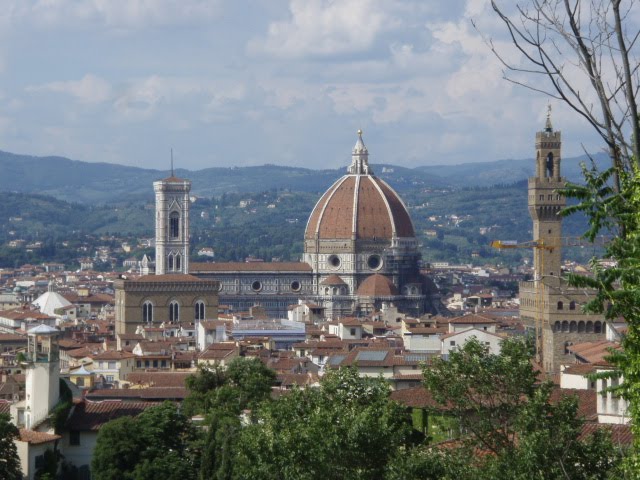
While wandering the gelato booths in Piazza del Duomo, one can't help but admire the neo-Gothic green, red, and white Duomo. Brunelleschi's Dome soars 100 meters into the sky and remains Florence's tallest building. The Baptistry, with its famous bronze doors, dates back to the 4th century, making it one of Florence's oldest buildings. Lorenzo Ghiberti's famous bronze doors were commissioned in 1401 to mark the city's deliverance from the plague. Each relief panel depicts a scriptural subject: 


   1. Aam and Eve are Expelled from Eden
   2. Cain Murders his Brother, Abel
   3. The Drunkenness of Noah and his Sacrifice
   4. Abraham and the Sacrifice of Isaac
   5. Esau and Jacob
   6. Joseph Sold into Slavery
   7. Moses Received the Ten Commandments
   8. The Fall of Jericho
   9. The Battle with the Philistines
  10. Solomon and the Queen of Sheba


Piazza della Repubblica is the site of the old Roman forum and served as the city's main food market until the 1860's, when it was redeveloped and the triumphal arch was added. The inscription "Antico centro della citta, da secolare squalore, a vita nuova restituito" - "the ancient center of the city, squalid for centuries, restored to new life" - makes a derogatory reference to that fact that the piazza is the site of the old Jewish ghetto.


The fortress-like Palazzo Vecchio rises up in the Piazza della Signoria. The palazzo originally served as the city council, later became the Medici family home, and is today still used as the town hall. The piazza's statues (some are copies) mark the city's major historical events. The Rape of the Sabine Women by Giambologna were carved from a single block of flawed marble. The Fontana di Nettuno is the Roman god surrounded by water nymphs and commemorates Tuscan naval victories.


The Ponte Vecchio (Old Bridge) is aptly named as it is not only Florence's oldest wholly-stone bridge, but also its' most famous. Once occupied by butchers, the tenants are now jewelers and art dealers. Padlocks are locked all along the Ponte Vecchio. It is popularly connected to idea of love and lovers: by locking the padlock and throwing the key into the river, the lovers became eternally bonded. But be careful! There is a 50€ penalty for those caught locking something to the fence.


Luca Pitti, a 15th century banker, built his palazzo against the Boboli hill. The Medici family acquired the palazzo in 1550 and turned the hillside into magnificent gardens. Labyrinthine avenues of cypress trees lead to bubbling fountains, grottos, and stunning views of the city. The stone amphitheater is decorated with statues based on Roman myths such as the Fountain of the Ocean sculptured by Giambologna. The large oval lawn is marked by an Egyptian obelisk . Even higher up the hill is Neptune's Fountain. The large Grotto by Buontalenti, in which the artist decorated internally and externally with stalactites to create the illusion of a natural grotto. Don't miss the statue of a portly Bacchus sitting astride a very strained turtle.


After all the climbing on the hillside, hit up the Firenze Gelato Festival for another round of tasting!

To view all my pictures of Florence, visit http://public.fotki.com/Davis2001r6/italy-2011/florence-italy/
Monday, May 24, 2010

Poppy Fields of Italy

The sight of a field of bright, blood-red poppies exploding in mass under the Italian sun is truly one to behold and one I won't soon forget.

An ancient Roman legend explains, rather romantically, how the poppy adopted the name 'Corn' Poppy. According to myth, the poppy was created by the Roman God of sleep, Somnus, in a period when Ceres, the Roman Goddess of grain, was having trouble sleeping after the loss of her daughter, Proserpina; therefore she clearly lacked the energy to make the corn grow. Somnus, realizing the gravity of the situation, allegedly quickly brewed a concoction from the poppy and offered it to Ceres and, so legend has it... "Ceres was soon sleeping like a baby again!" She soon felt rested and relaxed in no time! Ceres suddenly found the energy and turned her attention once again to the corn fields which miraculously began to grow well. The poppy's appearance along field margins has stood as a strong symbol to the Italian ever since and its presence ensures abundant harvests in the fields.

Saturday, May 22, 2010

Bergamo, Italy

Bergamo is divided into two parts, the Citta Alta (upper city) and Citta Bassa (lower city), with the two parts connected by a funicular.

Citta Alta is surrounded by 17th century cyclopic defensive walls, fortified by the Venetian Republic. Piazza Vecchia is the heart and jewel of Citta Alta and contains the city's most interesting architecture. The 12th century Torre del Comune, which still chimes 100 times nightly at 10pm in memory of the past age, when the town gates were closed at night for security reasons, offers stunning views over the city and beyond with a climb up its stairs. Palazzo Nuovo, also known as the Biblioteca Angelo Mai, was designed by Vincenzo Scamozzi in the early 17th century but was not completed until 1928. Palazzo della Ragione has the lion of St. Mark on its facade, testifying to the long period of Venetian dominance. It also connects Piazza Vecchia with the Piazza del Duomo by its 12th century portico. 

Piazza del Duomo opens up to reveal the Basilica della Santa Maria Maggiore. Giovanni da Campione's porch in the left transept, which is supported by columns departing from lions in Veronese marble, is quite notable. The arch has a frieze with hunting scenes. A loggia houses statues of St. Barbara, St. Vincent, and St. Alexander. At the peak is a Gothic niche by Hans von Fernach (1403) with the Madonna with Child flanked by St. Esther and St. Grata (1398). Next door is the Cappella Colleoni which is characterized by the use of tarsia and polychrome marble decorations in white, red and black lozenges. Over the main portal is a rose window, flanked by two medallions portraying Julius Caesar and Trajan.

From the Colle Aperto, another funicular runs up to Colle San Vigilio. A short walk on Via Castello brings you to the ruined Medieval castle. Stop to admire the views of the Citta Alta and Citta Bassa below with the foothills of the Alps to the north.

A foot path leads around the fortified walls of Citta Alta and to Porta San Giacomo, the main gate to Citta Alta. From Porta San Giacomo, you can continue down a cobbled path between the fortified walls to the Citta Bassa. It is quite a long way but well worth the walk! Continue along Via Sant' Alessandra to Piazza Pontida, a very lively piazza to relax by the fountain with an Italian granita to cool down with after the long hike down. Then wander down Via XX Settembre to window shop until reaching Viale Vittorio Emanuele, lined with some of the Citta Bassa's most stunning palazzos.  

To view all my pictures of Bergamo, visit http://public.fotki.com/Davis2001r6/italy-2011/bergamo/

Wednesday, April 28, 2010

Torino, Italy

Torino, site of the 2006 Winter Olympics, is located on the left bank of the Po River. Aside from being a city of porticos, Torino is also well known as the home of the Shroud of Turin.

The Shroud of Turin is a centuries old linen cloth that bears the image of a crucified man; a man that millions believe to be Jesus of Nazareth. It is the single most studied artifact in human history. Normally, the Shroud is kept sealed away in a climate controlled case in the Cappella della Santa Sindome in the Cattedrale di San Giovanni, but it went on public display for the first time in ten years on April 10, 2010. Millions of people, including the Pope, journeyed to Torino from all over the world to see the Shroud.

Many believe the Shroud is the cloth placed on the body of Jesus Christ at the time of his burial. A fire threatened the shroud in April 1997, but a fireman saved it from significant damage. In 2002, the Holy See had the shroud restored. The cloth backing and thirty patches were removed, making it possible to photograph and scan the reverse side of the cloth, which had been hidden from view. A ghostly part-image of the body was found on the back of the shroud in 2004.

On this visit to Torino, we also visited the Museo Egizio, which houses the second-largest Egyptian collection of any museum outside of Cairo. Some of the interesting holdings include several copies of the Egyptian Book of the Dead, the intact sarcophagus of Vizier Ghemenef-Har-Bak, and the tomb of the 14th century BC architect Kha and his wife, complete with furnishing and food. This is one of few Egyptian tombs spared by grave robbers.


To see all of our pictures of Torino, visit: http://public.fotki.com/Davis2001r6/italy-2011/torino-italy/

Valle d'Aosta, Italy

Upon crossing under Mont Blanc through the Mont Blanc Tunnel from France into Italy, you enter the region known as Valle d'Aosta. In 1031-1032 Humbert I of Savoy, the founder of the House of Savoy, received the title Count of Aosta from the Emperor Conrad II of the Franconian line and built himself a commanding fortification at Bard. The region was then divided among strongly fortified castles. Today, 70 castles survived in some form and you will see the panoramas of medieval military architecture on the drive from the Mont Blanc Tunnel into Italy. We stopped at several of the castles along our way.

Castello di Aymavilles was built in the 12th century and is characterized by the four cylindrical towers crowned by "murder holes" that enclose a central body with a square base. At the beginning of 18th century, the external fortifications were demolished and the land was arranged in terraces and gardens.

Continuing on the "wine road," you come to Saint-Pierre, which boasts two castles. Perched on a rocky spur, the Castello di Saint-Pierre predates its first mention in records of 1191, but owes its "fairy tale" appearance to 19th century additions, especially the turrets and machicolations on the main tower. Today, the building houses the Regional Museum of Natural Science. Built in 1420 around a pre-existing donjon, the Sarriod de la Tour Castle was inhabited by the Sarriod family until 1921

The Castello di Verres is unique and noteworthy as it consists of a large tower, which served as both accommodation and defense. This tower is a cube with all its sides measuring 30m. It stands majestic on a cliff above the river Evançon.

Forte di Bard is located in a narrow gorge next above the Dora Baltea river and was built by the House of Savoy around 1838. It once stopped a 40,000-strong French Army. 400 Austro-Piedmont soldiers held the pass for two weeks completely ruining Napoleon Bonaparte's plan of making a surprise attack on the Po Valley and Torino. The fort is now open to tourists as the Museum of the Alps and has additional art exhibitions and galleries.

Tuesday, April 27, 2010

Chamonix-Mont-Blanc, France

Chamonix is the home of the Mont Blanc summit and was the site of the 1924 Winter Olympics, the very first Winter Olympics. The valley of Chamonix was formed by glaciers during the Quaternary Era some ten thousand years ago when the town was buried under about 1000 meters of ice. Chamonix has been described as the "death-sport capital of the world" with its extensive winter sports such as ice climbing, extreme skiing, paragliding, and mountain climbing. Chamonix is also famous for its spectacular cable car up to the Aiguille du Midi at 3842 meters, constructed in 1955. It was then the highest cable car in the world. Today, the temperature was around 60° F in Chamonix. With snow on the mountains year round, you can enjoy a wonderful spring day like this and be skiing with just a short ride up the mountain. Wander around the town, taking in the striking views while enjoying a French crepe and a cappuccino.

At a height of 4,810 meters (15,781 feet), Mont Blanc is the highest European mountain west of Russia . The Les Bossons Glacier is distinctly visible from Chamonix. It originates in the highest summits of the massif and descends a total of 3600 meters, making it the largest icefall in Europe. It moves at 1 meter per day, also making it the fastest moving. The first mountaineers to successfully reach the summit of Mont Blanc were Paccard and Balmat on August 6, 1786 and this event traditionally marks the start of modern mountaineering. Some 20,000 mountain climbers now make the ascent each year and Tim plans to conquer Mont Blanc next summer.

To view all of our pictures of Chamonix, visit: http://public.fotki.com/Davis2001r6/italy-2011/france/

Cascade d' Arpenaz (Sallanches, France)

The Cascade d' Arpenaz is a huge waterfall at a total height of 1199 feet that literally shoots out of the cliff face Below, the waters gather into smaller waterfalls that notch and slide into the stream below. You can hike up a trail alongside the waterfall and picnic in the field just in front of it, all while hearing the power of the rushing water.

Check out a short video of the waterfall here.